In large-format communication and architectural graphics, material reliability directly influences visual impact and service life, and PVC Flex Banner manufactured by Shanghai MSD International Trade Co., Ltd. provides a technically advanced solution for demanding display environments. Developed to balance mechanical reinforcement with print surface optimization, this flexible banner material is engineered for projects that require dimensional stability, color vibrancy, and resistance to environmental stress over extended periods.
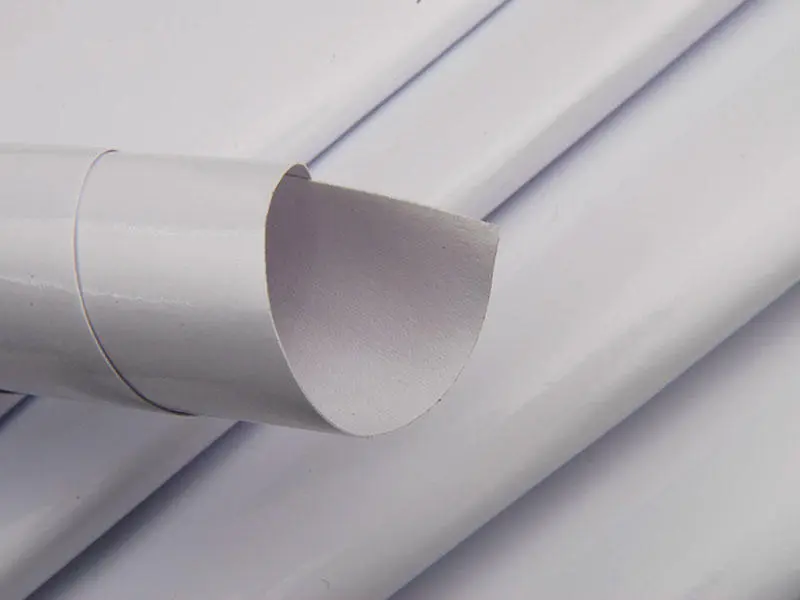
A key structural characteristic of PVC Flex Banner lies in its composite construction. Typically, the material consists of two PVC layers laminated over a high-strength polyester scrim. The internal mesh provides structural integrity, distributing stress evenly across the surface to prevent tearing or distortion. The outer PVC layers are formulated for smoothness and ink receptivity, enabling precise graphic reproduction. By adjusting yarn density in the scrim and modifying PVC layer thickness, manufacturers can tailor the banner’s tensile strength, flexibility, and weight to suit specific installation conditions such as high-wind outdoor billboards or suspended indoor signage.
The lamination process is critical to ensuring uniform bonding between layers. Two primary techniques are commonly used: cold lamination and hot lamination. In hot lamination, heat and pressure activate the PVC surface, fusing it tightly with the polyester mesh to create a stable composite structure with improved peel strength. Cold lamination, on the other hand, uses adhesive bonding at controlled pressure levels, offering cost efficiency for short-term applications. Shanghai MSD carefully manages lamination temperature, pressure, and line speed to prevent delamination, air entrapment, or uneven surface tension, which could affect long-term durability.
Surface calibration is another essential stage in manufacturing. The banner surface must maintain consistent roughness parameters to optimize ink anchoring without excessive absorption. Controlled embossing techniques can create matte finishes that reduce glare under strong lighting, particularly beneficial for stage backdrops and exhibition walls. Gloss finishes, by contrast, enhance color saturation and visual depth, often preferred for retail advertising and promotional campaigns. Anti-wicking treatments can also be applied along edges to prevent moisture penetration into the scrim core, preserving structural integrity in humid or rainy environments.
From a mechanical standpoint, PVC Flex Banner demonstrates excellent elongation and tensile performance. High-strength variants can achieve tensile values suitable for tension-mounted systems, ensuring the material remains taut without sagging. Tear propagation resistance is especially important in large outdoor installations, where minor edge damage can otherwise spread under wind load. Laboratory tear tests and stress simulations evaluate how the banner responds to point loading around grommets and mounting fixtures, helping ensure safety and reliability during extended exposure.
Environmental resistance is achieved through carefully selected stabilizers and UV absorbers incorporated into the PVC compound. These additives reduce polymer degradation caused by sunlight, limiting discoloration and brittleness over time. Temperature cycling tests simulate seasonal variation, confirming that the material retains flexibility in cold climates and dimensional stability under heat. Moisture resistance testing verifies that the composite structure resists swelling or delamination when exposed to rain or condensation, making it suitable for diverse geographic markets.
Fire performance is another important consideration for public installations. Flame-retardant formulations are available to comply with international fire safety standards required in exhibition halls, airports, and shopping centers. Testing procedures such as vertical burn assessments measure ignition resistance and flame spread, ensuring compliance without compromising flexibility or print performance. Shanghai MSD integrates flame-retardant technologies into selected product lines while maintaining consistent mechanical strength and surface quality.
Processing adaptability further enhances application possibilities. PVC Flex Banner can be cut with digital plotters, welded into oversized graphics, or stitched for reinforced structural sections. High-frequency welding technology enables seamless joining for extra-large billboards, maintaining uniform tension and appearance across wide spans. Reinforced corners and hem pockets can be integrated during fabrication, allowing compatibility with aluminum frame systems or pole-mounted installations.
In addition to performance considerations, production efficiency and environmental awareness play growing roles in banner manufacturing. Shanghai MSD adopts controlled material usage strategies and recyclable packaging systems to reduce waste during distribution. Stabilizer selection aligns with global environmental directives, ensuring safer production and end-use conditions.
With its engineered composite structure, controlled lamination processes, customizable surface finishes, and validated performance under mechanical and environmental stress, PVC Flex Banner serves as a dependable medium for high-impact visual communication across industries. For detailed product categories, technical specifications, and customization options, please visit Shanghai MSD’s official product page at https://www.shanghaimsd.com/product .



Share this page with your family and friends.